

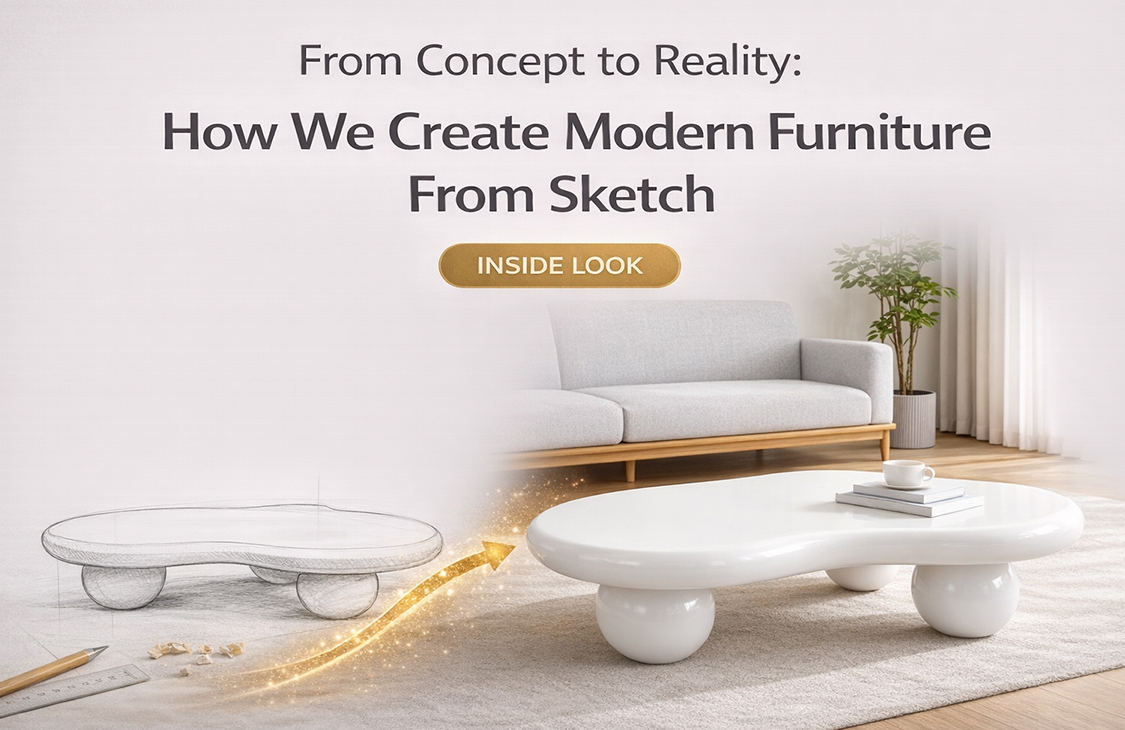
A Full Process Reveal Using the Cloud Coffee Table with Ball Legs
In the furniture industry, many factories claim they can produce products based on drawings. However, true customization capability goes far beyond simply copying a design.
Real customization means having the ability to transform a designer’s concept into a product that can be manufactured, mass-produced, sold in the market, and delivered consistently.
From the initial concept to the final product, a custom furniture project typically goes through several key stages, including:
· Design interpretation
· Structural engineering optimization
· Material and finishing selection
· Prototype development and testing
· Mass production control
· Packaging and transportation planning
Each step directly influences the quality, durability, and commercial success of the product.
In this article, we will use the AHOME Cloud Coffee Table with Ball Legs as an example to demonstrate how a design concept evolves into a finished furniture product.
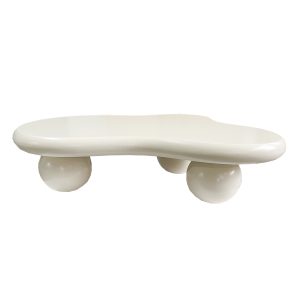
AHOME 39" Cloud Coffee Table with Ball Legs
Step 1: Design Interpretation and Structural Optimization
In most custom furniture projects, clients usually provide different types of inspiration materials, such as:
· Hand-drawn sketches
· 3D renderings
· Dimension reference drawings
· Benchmark product photos from the market
These materials typically represent a design concept, but they cannot be directly used for manufacturing.
Therefore, before production begins, the design must go through engineering analysis and structural optimization.
At AHOME, our engineering team performs several key evaluations.
Structural Load Analysis
Furniture must withstand weight and daily use over time. Therefore, structural stability is one of the most important factors.
For a coffee table, we evaluate:
· Load-bearing capacity of the tabletop
· Weight distribution across table legs
· Long-term stability during daily use
Tabletop Thickness Evaluation
The thickness of the tabletop affects both structural performance and aesthetics.
If the tabletop is too thin, it may result in:
· Deformation over time
· Insufficient load-bearing capacity
If it is too thick, it increases cost and may disrupt the visual balance of the design.
Our goal is to find the ideal balance between structural strength and visual proportion.
Table Leg Load Distribution
The cloud coffee table features a three-ball leg support structure, which creates a unique artistic appearance.
However, compared to traditional straight legs, this structure introduces additional engineering challenges.
Our engineers analyze:
· Load distribution among the three spherical legs
· The overall center of gravity
· Stability during real usage
Connection Structure Optimization
The connection between the tabletop and the legs is also a critical structural component.
We analyze:
· Fastening strength
· Assembly methods
· Long-term durability
This cloud coffee table has several unique design characteristics:
· Irregular cloud-shaped tabletop
· Three spherical support legs
· Smooth curved edge design
Using engineering software, we simulate and evaluate:
· Whether the ball leg positions are balanced
· Whether the center of gravity is stable
· Whether the tabletop is prone to deformation
Through this engineering process, we ensure that the design remains visually attractive while also being suitable for commercial mass production.
Step 2: Material Selection and Manufacturing Process
Once the structure is finalized, the next step is determining materials and production processes.
This stage considers several factors, including brand positioning, target market, and cost structure.
Panel Material Selection
Common materials used in furniture manufacturing include:
· MDF
· Solid wood
· Plywood
· Veneered boards
For this cloud coffee table, we selected:
High-density MDF
This material offers several advantages:
· Smooth surface quality
· Suitable for complex curved shapes
· Excellent compatibility with high-end paint finishing
Surface Finishing Method
Surface finishing significantly influences the visual appearance and market positioning of the product.
Common finishing methods include:
· Spray painting
· Wood veneer application
· Special texture finishes
For this product, we used:
High-quality spray painting
This finish provides:
· A smooth and refined surface
· A modern, premium appearance
Paint Gloss Level
Depending on the design style, different gloss levels can be applied:
· Matte
· Semi-matte
· High gloss
Each option creates a different visual effect and market positioning.
Color Sampling
Before production begins, color samples are prepared and confirmed with the client.
This ensures the final color matches the original design intent.
For the cloud coffee table, the most critical processes include:
· Curved surface sanding
· Ball leg spray painting
· Rounded edge finishing
These processes are essential to achieving the product’s premium design quality.
Step 3: Prototype Development and Detail Adjustment
Before entering mass production, a prototype sample must be produced.
The prototype stage is one of the most important steps in the customization process.
During this stage, we carefully evaluate multiple aspects of the product.
Tabletop Curvature Evaluation
The defining feature of this coffee table is its irregular cloud-shaped outline.
The edges must be repeatedly refined to ensure:
· Smooth and natural curves
· Comfortable touch
· Balanced visual proportions
Ball Leg Connection Strength
The connection between the spherical legs and the tabletop must be strong enough for long-term use.
We test:
· Structural stability
· Connection strength
Paint Surface Inspection
The painted surface must meet strict standards:
· Even coating
· No visible particles
· No color inconsistencies
Stability and Load Testing
Basic load tests are conducted to verify that the table performs well under real usage conditions.
If any improvements are needed, we make adjustments such as:
· Additional sanding
· Adjusting paint layers
· Reinforcing internal structure
Only after the prototype is fully approved do we proceed to mass production.
Step 4: Mass Production and Consistency Control
For furniture with irregular shapes, one of the biggest challenges during mass production is maintaining consistency.
Potential issues include:
· Variations in tabletop curvature
· Differences in ball leg dimensions
· Color inconsistencies between batches
To ensure consistency, we implement several control measures.
Mold Positioning
Custom molds are used to control the product shape and ensure consistency.
Standardized Process Parameters
Production processes are standardized, including:
· Sanding duration
· Number of paint layers
· Drying temperature
Unified Batch Painting
Products within the same batch follow the same painting process to minimize color differences.
Through these methods, we ensure that mass production products match the approved sample quality.
Step 5: Packaging and Transportation Planning
Custom furniture often has unique shapes, which require specially designed packaging solutions.
For this cloud coffee table, we developed a dedicated packaging structure.
Independent Tabletop Protection
The tabletop is wrapped with multiple protective layers to prevent scratches during transportation.
Fixed Foam Positioning for Ball Legs
Custom foam inserts hold the ball legs firmly in place inside the carton.
Reinforced Outer Carton
Heavy-duty cartons are used to improve compression resistance.
This packaging system helps prevent:
· Product movement during shipping
· Internal collisions
· Structural damage during ocean transport
Why Customization Capability Determines Long-Term Cooperation
In the furniture industry, factories capable of long-term cooperation must possess several core capabilities:
· Design interpretation capability
· Structural engineering expertise
· Surface finishing control
· Stable mass production capability
· Packaging and transportation management
Only factories with these integrated capabilities can successfully transform creative designs into commercially viable products.
The AHOME Customization Philosophy
At AHOME, we do more than simply manufacture products based on drawings.
Our goal is to help clients transform design ideas into products that can be mass-produced, sold in the market, and generate profit.
If you are looking for a furniture manufacturing partner capable of supporting product customization and development, we invite you to explore our capabilities.
AHOME 39” Cloud Coffee Table with Ball Legs
We look forward to helping more brands bring their design ideas to life and successfully launch them into the market.