

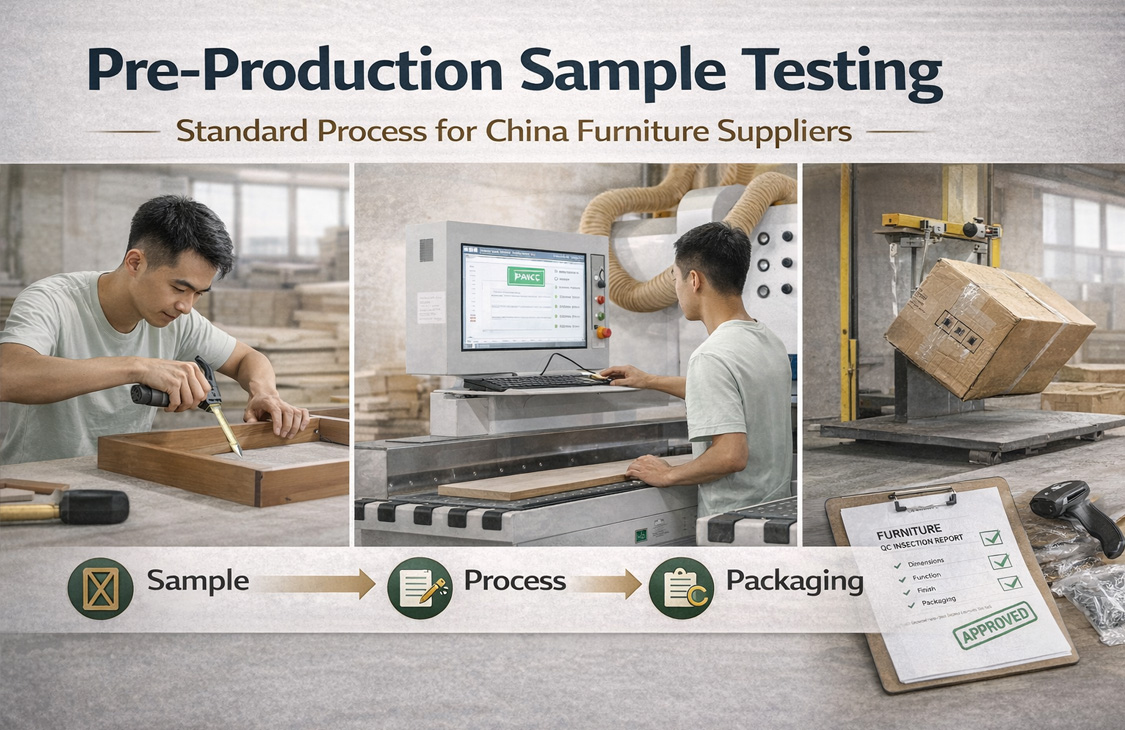
In furniture export, the sample stage is one of the most critical phases that determines product quality, transportation safety, and the efficiency of the entire supply chain.
For professional Chinese furniture suppliers, a systematic verification process should be completed before mass production begins. This process typically includes confirmation of product structure, surface finishing, functionality testing, packaging design, and container loading planning.
The purpose of the sample stage is straightforward: identify and solve potential problems before production, ensuring smooth mass manufacturing while reducing risks such as product defects, transportation damage, and costly after-sales issues.
Below is a standard sample verification process widely used in the furniture export industry.
1. Structure and Dimension Verification
The first step in the sample stage is confirming the product structure and dimensional accuracy.
This stage determines whether the design is suitable for stable mass production.
Key aspects usually inspected include:
· Structural stability – ensuring the furniture frame and joints are firm and stable without wobbling.
· Load-bearing capacity – verifying that critical components such as tabletops, shelves, or bed frames can withstand designed weight loads.
· Hardware functionality – confirming that hinges, sliders, and connectors operate smoothly and reliably.
· Board thickness – ensuring panels match the specified standards (commonly 15mm, 18mm, or 25mm boards).
· Dimensional accuracy – checking that actual measurements match the design drawings and tolerances.
During this stage, suppliers typically assemble the product fully and simulate real usage conditions.
Only after the structure and dimensions are fully confirmed can the product move into mass production.
2. Surface Finish Verification
For MDF furniture, veneer furniture, or panel furniture, surface finishing plays a major role in product appearance and market competitiveness.
During the sample stage, suppliers need to confirm several aspects:
· Color and color consistency
The sample ensures the product color matches the design specification and prevents noticeable color variation between components.
· Painting quality
Verification of finish types such as matte, semi-matte, or high-gloss.
The surface should be smooth, uniform, and free of defects such as dust particles, orange peel texture, or uneven coating.
· Paper laminate or veneer effect
For wood grain finishes, suppliers confirm pattern direction, adhesion quality, and edge finishing.
Once the sample is approved, it becomes the “golden sample” for production.
Mass production must follow the same finishing standard to avoid batch color differences.
3. Function and Load Testing
Furniture products must not only look attractive but also perform reliably in everyday use.
Therefore, the sample stage includes functional and durability testing.
Common tests include:
· Tabletop load testing
Ensuring the tabletop can support weight without bending or structural damage.
• Drawer open-and-close testing
Repeated operation to test the durability of drawer slides and internal structure.
· Structural stability testing
Confirming the product remains stable and balanced during normal use.
· Connector durability testing
Evaluating the performance of screws, fittings, and assembly hardware.
Through these tests, potential structural issues can be discovered early.
Solving problems at the sample stage prevents costly rework during mass production.
4. Packaging Testing (Critical Step)
In furniture export, transportation damage is one of the most common after-sales problems.
Even well-manufactured furniture can be damaged during shipping if packaging is insufficient.
Therefore, packaging must be verified at the sample stage.
Important elements include:
· Foam protection thickness
Ensuring critical areas receive sufficient impact protection.
· Corner protection design
Preventing damage to furniture edges during transportation.
· Outer carton strength
Confirming whether the carton uses appropriate materials such as 5-layer or 7-layer corrugated cardboard.
· Packaging size optimization
Balancing protection and shipping efficiency.
Professional suppliers often conduct drop tests or simulated transportation tests to evaluate packaging reliability.
Once the packaging design is approved, mass production packaging must strictly follow the same standard.
5. Container Loading Planning and Volume Calculation
In furniture export, container loading efficiency directly impacts shipping costs and profit margins.
For this reason, experienced suppliers conduct container planning during the sample stage.
This includes calculating:
· CBM (cubic meter) per package
· Loading quantity for 20GP and 40HQ containers
· Whether the structure can be optimized for knock-down design
· Opportunities to reduce packaging volume
Through proper container planning, suppliers can help buyers:
· Reduce ocean freight costs
· Increase container loading efficiency
· Improve logistics planning
· Optimize overall profit margins
For many importers, this step plays a significant role in determining final product pricing in the market.
At AHOME, we adopt a knock-down design to save packaging space and help customers reduce costs as much as possible.
Why the Sample Stage Is Crucial
If the sample stage is not thoroughly verified, common problems in mass production may include:
· Batch color inconsistencies
· Dimensional deviations
· Structural instability
· Transportation damage
· Production delays
Once issues appear during mass production, the cost of solving them becomes significantly higher.
Industry experience shows that a systematic sample verification process can prevent up to 80% of potential production risks before manufacturing begins.
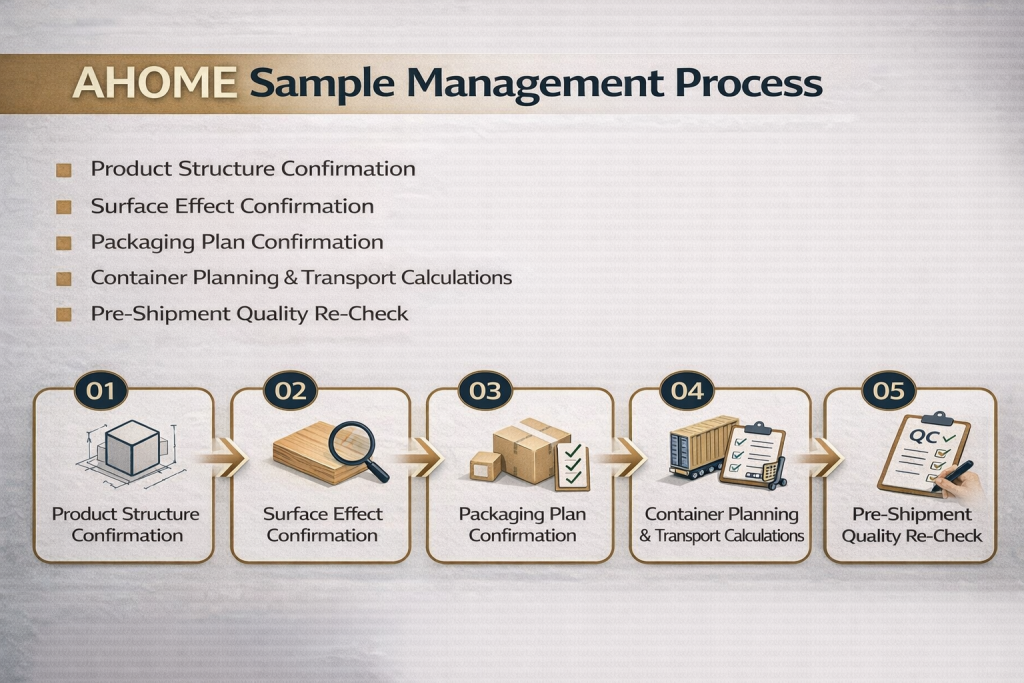
AHOME’s Sample Management Process
At AHOME, we implement a structured sample management system to ensure that the final products remain fully consistent with approved samples.
Our process includes:
· Structural verification
· Surface finishing confirmation
· Packaging verification
· Container loading planning
· Final pre-shipment quality check
Through standardized procedures, we ensure:
· Consistency between samples and mass production
· Stable manufacturing quality
· Reduced transportation risks
· A more reliable supply chain for our clients
If you are looking for a Chinese furniture supplier with a mature sample management system,
feel free to contact AHOME. We are happy to provide sample development solutions and professional container loading suggestions to support your furniture importing business.