

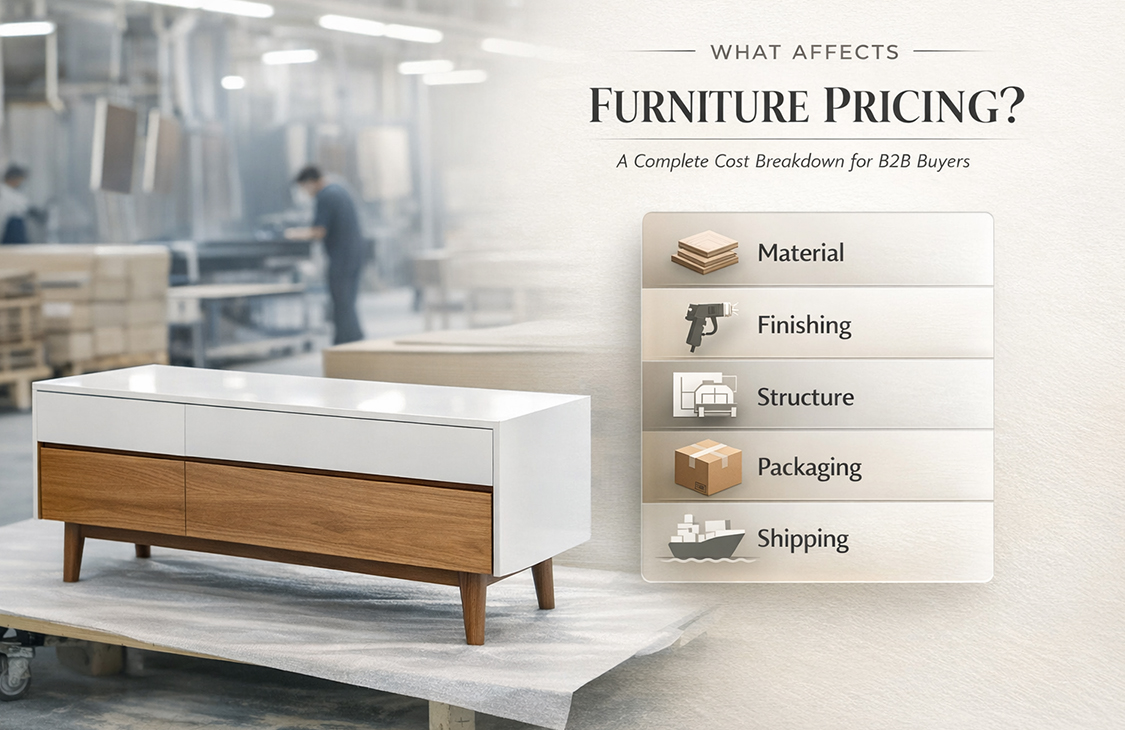
A Complete Cost Breakdown Guide for B2B Buyers
In furniture sourcing, many buyers ask the same question:
Why do products that look similar have such different prices?
For B2B procurement, “price” is never just a number. It reflects material grade, finishing yield, structural complexity, packaging standards, shipping efficiency, and after-sales responsibility. Understanding what drives pricing helps you control budgets—and avoid quality risks caused by over-negotiation.
In this guide, we break down the key factors behind furniture pricing from a manufacturer’s perspective, with practical tips B2B buyers can apply immediately.
1. Material Cost
Materials are the most direct driver of furniture pricing. Common options include:
· MDF (Medium-Density Fiberboard)
· Particleboard (PB)
· Solid wood (oak, pine, rubberwood, etc.)
· Veneer (natural veneer / engineered veneer)
· Melamine boards
· Metal frames (iron, stainless steel, aluminum)
· Acrylic, glass, stone, and other specialty materials
Even within the same category, costs vary significantly due to:
· Board density and stability
· Moisture control and anti-warp treatment
· Environmental compliance (E1/E0, CARB, FSC, etc.)
· Surface layer and adhesive system (odor, durability, stability)
Example logic:
· Paper lamination: lowest cost, ideal for high-volume e-commerce
· Veneer: premium texture, higher cost and higher production requirements
· Melamine: balanced durability and consistency, often requires MOQ to optimize production
2. Finishing Process
Finishing is often overlooked—but can create major price gaps. Common finishes include:
· NC / PU / UV painting
· Matte / high gloss / textured coatings
· Thermofoil / vacuum forming
· Paper lamination
· Veneer sealing + topcoat systems
Why the difference?
Because finishing changes requirements for equipment, labor hours, defect rate, and rework rate. The more refined the finish, the higher the control cost.
PU painting (premium) often means:
· smoother surface and better feel
· stronger durability (depending on coating system)
·strict workshop requirements (dust-free environment, controlled temperature/humidity) → higher cost
3. Design & Structure Complexity
More complex designs cost more. Pricing increases when products include:
· irregular shapes (cloud tables, flower-shaped tops, curved panels)
· special legs or columns (ball legs, fluted columns, ribbed designs)
· molds or custom tooling
· multi-layer structures or hidden hardware
· functional components (soft-close slides, lift-up tops, adjustable systems)
Core formula:
Complex design = more labor + higher defect rate + longer production time
4. Manufacturing & Labor Cost
Production cost changes significantly depending on:
· hand sanding vs. machine processing
· small-batch production vs. mass production
· standard items vs. customization
Key points:
·Small orders → higher unit cost due to setup and line change loss
·Customization → extra cost for sampling, structure validation, packaging tests, tooling
·Urgent lead time → overtime, priority scheduling, extra QC
5. Packaging Cost
Packaging affects both cost and damage rate. Common packaging options include:
· standard cartons
· heavy-duty cartons
· foam/EPE/corner protection
· drop-test packaging (for e-commerce)
· pallets/wood crates (for export and stacking safety)
Better packaging means:
· lower damage rate
· fewer claims
· better customer experience
· …but higher cost
6. Shipping, CBM & Container Loading Efficiency
Shipping is a major part of landed cost. Key drivers include:
· KD design (knock-down)
· nesting/stacking capability
· CBM per item and weight
· container loading quantity (20GP / 40HQ) and reinforcement needs
Example:
KD can reduce shipping cost by 30%+, but may increase assembly cost and after-sales risk. The right solution balances:
shipping efficiency vs. user experience vs. service risk
7. MOQ & Volume
Volume is one of the strongest price variables:
· higher volume → lower unit price
· lower volume → higher unit price
Because volume helps:
· spread tooling/development cost
· improve production efficiency
· reduce line change loss
· strengthen raw material purchasing power
Tip: for multi-SKU sourcing, negotiate shared MOQ across the same series/material/finish.
8. QC & After-Sales Standards
Stronger QC increases cost—but reduces overall risk. Typical cost drivers include:
· inspection ratio (20% / 50% / 100%)
· pre-shipment full inspection
· QC reports, measurement reports, loading video inspection
· after-sales policies (spare parts, discount, replacement)
Core logic:
Higher QC standards = more stable quality + lower total cost of ownership (TCO)
9. Supplier Positioning
Different suppliers price differently due to positioning and capability:
· low-cost factories: lower price, higher risk in consistency/lead time
· mid-to-high manufacturers: slightly higher price, stronger stability and QC system
In B2B sourcing, reliability often matters more than the lowest unit cost.
Buyer Checklist: Questions to Ask Suppliers
1. Material grade and compliance standard?
2. Which finishing process and durability standard?
3. Any tooling/mold required? KD possible? Stability/load test available?
4. Packaging configuration and drop/stack test?
5. Standard lead time and peak-season lead time? Pre-production sample process?
6. QC plan and acceptance criteria?
7. Damage/missing parts/color variance handling and spare parts ratio?
Conclusion
Furniture pricing is not driven by one factor. It is shaped by materials, finishing, design complexity, manufacturing method, packaging, shipping efficiency, order volume, QC standards, and supplier reliability.
In short:
Price reflects the combined value of quality, design, and supply stability.
Contact AHOME® for B2B Sourcing Support
At AHOME®, we provide competitive pricing—while focusing on:
· stable quality control
· flexible MOQ solutions
· design-driven product development
· efficient packaging and shipping optimization
Contact us for a quote, samples, or customization solutions.