


10 Essential QC Points Every Professional Buyer Should Know
In recent years, more retailers, e-commerce brands, and project buyers have begun sourcing furniture from China. With a mature manufacturing ecosystem, strong supply chains, and competitive pricing, China has become one of the most important global sourcing hubs for furniture.
However, many buyers—especially those working with a supplier for the first time—often worry about potential quality risks, such as:
· Bulk production quality not matching the approved sample
· Deformation or damage after ocean shipping
· Color inconsistencies across batches
· Structural instability or weak connections
In reality, sourcing furniture from China does not automatically mean higher risk.
The real risk usually comes from a lack of understanding of the quality control process.
Experienced buyers typically manage risks by implementing systematic Quality Control (QC) procedures before production, during production, and before shipment.
For retailers, e-commerce brands, and project procurement teams, the following 10 critical QC checkpoints can help prevent major quality problems in bulk orders.
1. Is the Board Thickness Truly as Specified?
The thickness of furniture panels directly affects the strength and durability of the product.
However, in some low-cost manufacturing situations, the following problems may occur:
· Actual board thickness is lower than the quoted specification
· Internal filling materials are insufficient
· Lower-grade materials are substituted without notice
For example, a quotation may specify 18mm MDF, but the factory may use 15mm or thinner boards in production.
While such differences may not be immediately visible, they can lead to long-term issues such as:
· Reduced load-bearing capacity
· Structural deformation
· Shorter product lifespan
Procurement recommendations:
· Clearly define board thickness in technical specifications
· Confirm materials during the sample stage
·Conduct random inspections of board thickness during production
These steps can significantly reduce quality disputes later.
2. Is the Moisture Content Properly Controlled?
Moisture content in wood-based panels is one of the most critical factors affecting furniture stability.
If moisture content is too high, several issues may occur during shipping or usage:
· Product deformation after ocean transportation
· Panel cracking
· Changes in joint gaps or assembly structure
These problems are especially common when furniture is exported across different climate zones—for example, from China to Europe or North America.
Professional manufacturers typically control the moisture content within a stable range suitable for export markets.
Proper moisture control helps ensure the furniture remains stable after shipping and during long-term use.
3. Is the Paint Finish Even and Consistent?
The paint finish plays a major role in both product quality and market positioning.
During QC inspection, buyers should carefully check for:
· Visible color differences
· Paint drips or uneven coating
· Surface particles or rough texture
· Pinholes or bubbles
These problems are particularly noticeable on matte finishes, which require more precise painting control.
If painting quality is inconsistent, bulk products may show:
· Different shades across units
· Uneven gloss levels
Such issues often lead to returns or customer complaints, especially in retail and e-commerce channels.
4. Is the Veneer Properly Applied?
For furniture using wood veneer finishes, veneer quality is another important checkpoint.
Common veneer problems include:
· Edges lifting at corners
· Cracks at joints
· Bubbling after long-term use
These issues are often related to:
· Adhesive quality
· Hot pressing processes
· Edge finishing techniques
During inspection, buyers should check:
· Whether veneer edges are fully covered
· Whether surfaces are smooth and flat
· Whether the bonding is strong and stable
High-quality veneer finishing should appear seamless with natural grain alignment.
5. Are Structural Connections Secure?
Furniture durability depends heavily on the strength of its structural connections
Some low-cost production may involve shortcuts such as:
· Loose screws or fasteners
· Poorly installed inserts
· Insufficient load-bearing testing
These issues may not appear immediately but can cause long-term problems, such as:
· Furniture wobbling
· Loosened connections
· Structural failure
Therefore, it is recommended to conduct structural testing during the sample stage, including:
· Load-bearing tests
· Stability and wobble tests
Early testing can help identify structural weaknesses before mass production.
6. Can Color Consistency Be Controlled in Bulk Production?
Color variation is a common challenge in furniture manufacturing.
This can occur due to:
· Natural variation in materials
· Differences between paint batches
Without proper control, bulk orders may show noticeable color differences.
This issue is particularly sensitive in:
· E-commerce platforms
· Retail chain stores
To reduce this risk, suppliers should confirm:
· Consistent paint batch usage
· Standardized painting parameters
· Mid-production inspection
Color consistency is critical for maintaining low return rates.
7. Are Dimensional Tolerances Within Acceptable Range?
Dimensional accuracy is another important QC factor during mass production.
Common problems include:
· Size deviations
· Improper proportions after assembly
· Misaligned drilling holes
Such issues often only become visible during assembly.
Therefore, it is recommended to perform dimensional inspections during production, rather than relying only on final inspections.
Mid-production QC checks allow problems to be corrected early.
8. Is the Packaging Suitable for Ocean Shipping?
Furniture packaging plays a crucial role in preventing shipping damage.
Many after-sales problems are actually caused by transportation damage, not manufacturing defects.
During QC inspection, buyers should verify:
· Foam protection thickness
· Corner protection design
· Carton strength
· Whether drop tests have been conducted
Experience shows that products with extremely low packaging costs often have higher damage rates.
Professional suppliers usually design packaging structures specifically for ocean shipping conditions.
9. Is There Mid-Production Quality Control?
Some suppliers only perform inspections before shipment. However, this approach often identifies problems too late.
Experienced manufacturers usually conduct multiple inspections during production, such as:
· Dimensional checks
· Structural inspections
· Surface quality inspections
Mid-production QC helps detect issues early and prevents large-scale defects in bulk production.
10. Is the After-Sales Policy Clearly Defined?
Even with strict quality control, international shipping still involves certain risks
Therefore, it is important to clarify the supplier’s after-sales policy in advance.
Buyers should confirm:
· How transportation damage is identified
· Whether replacement parts can be provided
· Whether compensation policies are available
Clear after-sales policies help reduce disputes and protect both parties.
For long-term partnerships, transparent policies are often more valuable than the lowest price.
The Core Mindset of Professional Procurement
Avoiding quality pitfalls is not simply about relying on third-party inspection companies.
The most effective approach is to work with suppliers that have:
· Dedicated internal QC teams
· Mature production management systems
· Strong export experience
Suppliers with these capabilities are more likely to provide stable and reliable product quality.
AHOME’s Quality Control System
At AHOME, we implement a structured quality control process to help clients manage risks during production rather than dealing with problems afterward.
Our QC system includes:
· Raw material inspection
· Mid-production quality checks
· Pre-shipment product inspection
· Packaging verification
· Video inspection support
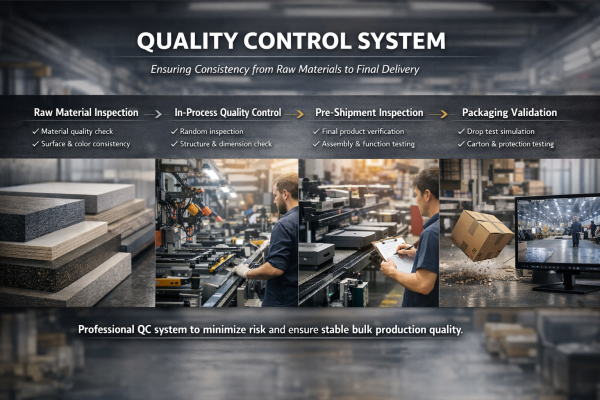
Through these processes, we ensure consistent product quality and help our clients reduce risks in international trade.
If you are looking for a stable, transparent, and risk-controlled furniture manufacturing partner in China, feel free to contact us to learn more about AHOME’s QC management system.