

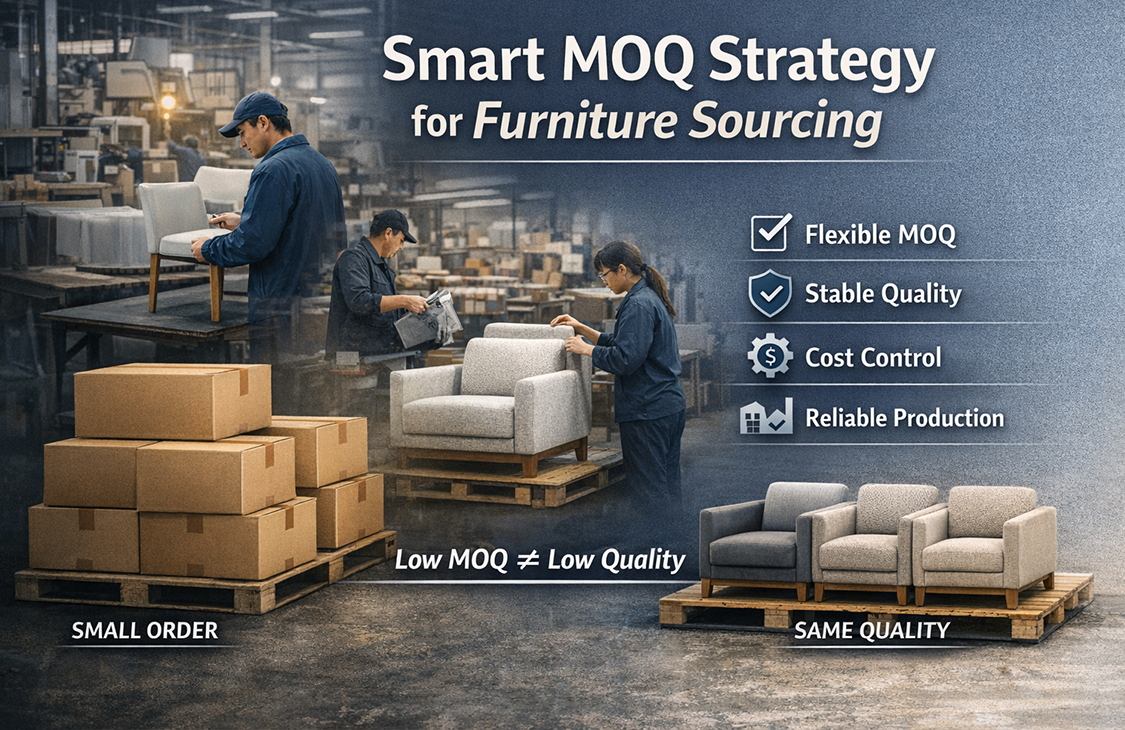
In furniture sourcing, Minimum Order Quantity (MOQ) is often one of the biggest challenges faced by new brands, e-commerce sellers, and small to medium-sized retailers.
For buyers, small orders often mean:
· Lower inventory risk
· Greater flexibility to test new products
· More manageable capital investment
· Faster market feedback
However, many buyers worry about one important question:
Will smaller orders lead to lower product quality or reduced manufacturing standards?
In reality, small-batch sourcing does not automatically mean lower quality. The key factor is not the order quantity itself, but the production management capability of the supplier and the procurement strategy used by the buyer.
With the right approach and the right manufacturing partner, small-batch furniture sourcing can maintain high quality while helping brands manage risk during early growth stages.
Below, we explore how small orders can be executed effectively without compromising product quality.
1. Why Furniture Manufacturers Usually Set an MOQ
In the furniture industry, most factories establish a minimum order quantity. This is not simply a business strategy—it is closely related to the structure of manufacturing and supply chains.
MOQ requirements usually exist for several reasons.
Raw Material Procurement Costs
Furniture production requires large amounts of raw materials, such as:
· MDF panels
· Solid wood materials
· Hardware components
· Paint and finishing materials
· Packaging materials
These materials are usually purchased in bulk to achieve reasonable pricing.
If order quantities are too small, factories may not meet the minimum purchase requirements of their material suppliers, which increases the overall material cost.
Therefore, MOQ helps balance raw material procurement efficiency and production costs.
Production Line Changeover Costs
Furniture manufacturing typically follows a structured production sequence, such as:
· Panel cutting
· Sanding and edge finishing
· Painting or veneer application
· Product assembly
· Packaging
When a production line switches from one product to another, the factory must adjust equipment, change molds, and reorganize production planning.
These changes involve additional costs, such as:
· Equipment adjustment time
· Worker retraining or repositioning
· Preparation of materials and tools
If order quantities are very small, these setup costs are distributed across fewer products, increasing the unit cost significantly.
Paint and Veneer Batch Management
Surface finishing processes are typically managed in batches, including:
· Paint color batches
· Veneer batches
· Texture finishing processes
To ensure color and finish consistency, factories usually produce items within the same batch.
If the order quantity is too small, the factory may need to run a separate finishing batch, which reduces production efficiency.
Packaging and Logistics Costs
Furniture products typically require customized packaging for international transportation, such as:
· Custom foam protection structures
· Reinforced corrugated cartons
· Corner protection designs
These packaging solutions are often developed specifically for each product.
When the order quantity is too small, packaging costs cannot be efficiently distributed across units.
Therefore, from the factory’s perspective, small orders usually mean higher unit production costs.
However, it is important to emphasize that higher costs do not mean lower quality. Professional manufacturers typically support small orders through better production planning rather than compromising materials or workmanship.
2. Three Core Strategies for Small-Batch Furniture Orders
For buyers who want to minimize inventory risks, small-batch purchasing is possible—but it requires a more strategic approach.
The following three strategies are widely used in the furniture industry.
1. Choose “Standard Structure + Customized Surface”
If a product requires fully customized structural development, such as:
· New structural design
· New mold development
· New installation systems
the MOQ will usually be higher because the factory must invest additional engineering and production resources.
A more practical approach is:
Using a proven structure with customized surface finishes.
For example:
· Use a standard coffee table structure
· Customize the paint color
· Customize the wood veneer pattern
· Customize the surface texture
This approach offers several advantages:
· No need to redevelop complex structural designs
· Lower development and tooling costs
· Faster product development timelines
· Maintains product differentiation through visual design
For new brands and e-commerce companies, this is a very common and effective product development strategy.
2. Use Mixed Container Shipping
If a single SKU does not meet the MOQ requirement, buyers can use mixed container shipping.
Common methods include:
· Mixing multiple product models
· Combining different sizes in one shipment
· Mixing different color variations
For example, a container may include:
· Coffee tables
· Side tables
· Small storage cabinets
By carefully planning product CBM (cubic meter volume), buyers can maximize container space usage.
This strategy helps:
· Reduce MOQ pressure for individual SKUs
· Improve shipping efficiency
· Lower per-unit transportation costs
For cross-border e-commerce brands and smaller retailers, this is a highly practical purchasing strategy.
3. Use Phased Order Testing
For new products or new brands, placing large orders immediately often carries significant risk.
Instead, buyers can adopt a phased procurement strategy.
Stage 1: Sample Confirmation
Test the product sample to evaluate:
· Structural stability
· Surface finishing quality
· Product proportions and dimensions
Samples can also be used for marketing preparation, such as product photography.
Stage 2: Small Trial Order
Once the sample is confirmed, a small batch order can be placed to test:
· Market demand
· Sales performance
· Customer feedback
Stage 3: Scale Production
If the product performs well in the market, the order quantity can gradually increase.
This phased strategy allows buyers to:
· Test market response
· Control inventory risk
· Reduce initial financial pressure
For new brands, this approach provides a more sustainable growth path.
3. How to Maintain Quality in Small Orders
Many buyers worry that small orders may lead factories to lower quality standards.
In reality, the real risk lies not in order size but in production management.
Even small orders should maintain the same standards as large production orders.
Consistent Material Standards
Regardless of order size, material specifications should remain the same, including:
· MDF board density
· Hardware quality level
· Environmental compliance standards
Consistent Painting Standards
The painting process should remain identical, including:
· The same painting workflow
· The same paint suppliers
· The same gloss level standards
Consistent QC Procedures
Small orders should still follow full QC procedures, including:
· Raw material inspections
· Mid-production inspections
· Final pre-shipment inspections
Consistent Packaging Standards
Packaging should not be simplified due to smaller order quantities.
Standard packaging should include:
· Foam protection structures
· Corner protection
· Strong outer cartons
Working with factories that have internal QC teams helps ensure consistent quality even for smaller production runs.
4. How to Identify Suppliers Suitable for Small Orders
Not all furniture manufacturers are well-suited for small-batch orders.
When evaluating suppliers, buyers should confirm several key factors.
Do They Support Mixed Containers?
Suppliers that support mixed shipments offer greater flexibility.
Do They Support Small Custom Orders?
Some factories have flexible production systems that allow smaller MOQ requirements.
Do They Have Standardized Production Processes?
Well-structured production processes ensure consistent product quality even with smaller orders.
Are They Interested in Long-Term Partnerships?
Experienced manufacturers usually focus on building long-term partnerships rather than maximizing profit from a single order.
For buyers, working with such suppliers often provides better long-term business stability.
5. AHOME’s Small Order Support Strategy
At AHOME, we understand the challenges faced by new brands, e-commerce businesses, and growing retailers during the early stages of product sourcing.
Therefore, while maintaining strict quality standards, we offer flexible MOQ solutions to support smaller orders.
Our approach includes:
· Small-batch trial order support
· Mixed container shipping solutions
· Fast development using proven structures
· Customized surface finishing options
· Full-process QC management
Through these strategies, we help clients reduce inventory risks while maintaining stable product quality.
If you are looking for a Chinese furniture manufacturer that can support small orders while maintaining high production standards, feel free to contact us to learn more about our flexible sourcing solutions.