

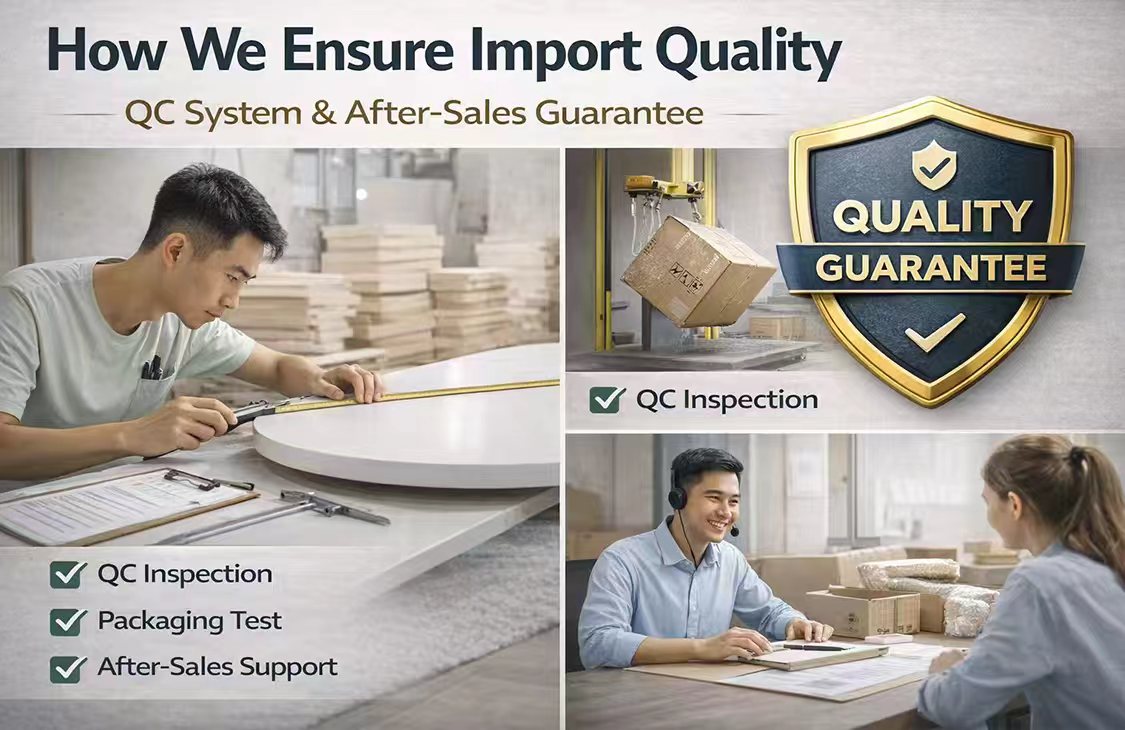
Our QC System & After-Sales Commitment for Global Importers
For furniture importers, the true cost of sourcing is never just the product price.
Unstable quality, shipping damage, inconsistent batches, and slow after-sales handling can quickly lead to:
· Return costs
· Warehouse losses
· Customer complaints
· Platform rating drops
· Brand reputation damage
In today’s competitive European and global furniture market, furniture import quality control has become one of the most critical factors for sustainable growth.
At AHOME, we understand these risks. That is why we have built a structured and system-driven Furniture Quality Control (QC) and After-Sales Management System, designed to help importers reduce risk and maintain supply chain stability.
1. Pre-Production Control: Confirming Materials and Structure Before Mass Production
Many quality problems originate before production even begins. For this reason, our process starts with strict pre-production verification.
Before bulk production, we conduct comprehensive checks on raw materials and structural design. This includes panel thickness confirmation, moisture content testing, surface flatness inspection, and environmental compliance validation.
At the sampling stage, we further verify structural stability, weight-bearing capacity, surface finish quality, color accuracy, and packaging methods.
Automation level also plays a critical role. The presence of CNC machinery directly impacts dimensional accuracy and batch consistency. In the e-commerce environment, even a 1mm deviation can result in assembly complaints, returns, and negative reviews.
The sample phase is not a formality — it is the most critical stage in preventing large-scale production issues. By validating structure and appearance in advance, we significantly reduce the risk of mass-production defects.
2. Mid-Production QC: Real-Time Process Inspection
Many suppliers only conduct inspection before shipment. However, relying solely on final inspection increases the risk of large-scale rework.
At AHOME, our mid-production QC system ensures quality monitoring during the manufacturing process
During production, our QC team performs:
· Dimensional tolerance checks
· Joint structure inspections
· Paint uniformity evaluation
· Color difference control
· Batch consistency monitoring
By identifying deviations early, adjustments can be made immediately. This approach shortens correction time, minimizes delays, and maintains batch stability.
In furniture manufacturing, prevention is always more efficient than correction.
3. Final Pre-Shipment Inspection: Comprehensive Quality Verification
Once production is completed, we conduct a structured final quality inspection (FQC) before shipment.
This inspection covers surface quality, structural performance, dimensional accuracy, and packaging integrity.
Surface inspection includes checking for scratches, color variation, air bubbles, paint particles, veneer lifting, and finishing defects.
Structural inspection verifies product stability, screw fastening, drawer smoothness, and load-bearing performance.
Dimensional confirmation ensures that length, width, height, and key structural measurements remain within approved tolerances.
Packaging inspection checks foam protection placement, corner protectors, carton strength, and barcode labeling accuracy.
To maintain transparency, we provide:
· Pre-shipment photos
· Detailed video reports
· Remote live inspection sessions
If required, we also support on-site third-party inspection companies.
For global importers, this transparency significantly reduces uncertainty before goods leave the factory.
4. Shipping Protection: Reducing Ocean Freight Damage Risk
Furniture shipping presents unavoidable risks, including carton drops, stacking pressure, container shifting, and humidity changes during long-distance transport.
Our export packaging system is designed to reduce these risks through multi-layer foam protection, reinforced corner guards, thickened outer cartons, fragile labeling, and secure container loading methods.
We also provide drop-test demonstration videos and packaging detail explanations when required.
Reducing shipping damage is not only about saving replacement costs — it directly protects brand reputation and customer satisfaction.
5. Batch Consistency Control: Critical for Retail and E-Commerce Brands
For retailers, e-commerce sellers, and supermarket chains, batch consistency is essential.
Customers expect products to match listing photos exactly. Color deviation or structural inconsistency across batches increases return rates and damages brand credibility.
To maintain consistency, we standardize raw material batches, color mixing ratios, paint parameters, and inspection standards across production cycles.
This structured consistency control helps reduce return rates, maintain online presentation stability, and strengthen brand image.
6. After-Sales Responsibility and Resolution Mechanism
Even with strict QC procedures, international transportation may involve unforeseen situations.
Our after-sales policy is structured around responsibility and solution-oriented cooperation.
The process typically includes damage photo confirmation, responsibility evaluation, spare part resupply, order credit adjustment, or reasonable compensation solutions depending on the situation.
We prioritize long-term partnerships over short-term dispute avoidance. Problem resolution comes before liability shifting.
For importers, reliable after-sales support is as important as manufacturing quality.
7. Why Internal QC Is More Important Than Third-Party Inspection Alone
Many buyers rely on third-party inspection agencies. While third-party inspection serves as a final checkpoint, it cannot replace an internal quality management system.
A supplier with an in-house QC team can:
· Detect problems during production
· Prevent large-scale rework
· Reduce correction costs
· Shorten inspection timelines
· Improve overall manufacturing efficiency
Third-party inspection is the last line of defense. Internal QC is full-process protection.
At AHOME, our goal is not only to pass inspection — but to prevent problems from occurring in the first place.
Building Long-Term Manufacturing Partnerships
At AHOME, we position ourselves not just as a supplier, but as a long-term manufacturing partner.
We serve:
· Furniture retailers
· E-commerce brands
· Hospitality projects
· Home furnishing chain systems
Through structured quality control systems and transparent after-sales policies, we help global clients stabilize their supply chains and reduce operational risks.
If you are looking for a China furniture manufacturer with a systematic quality management system, we welcome you to contact us for more information or schedule a remote factory tour.