

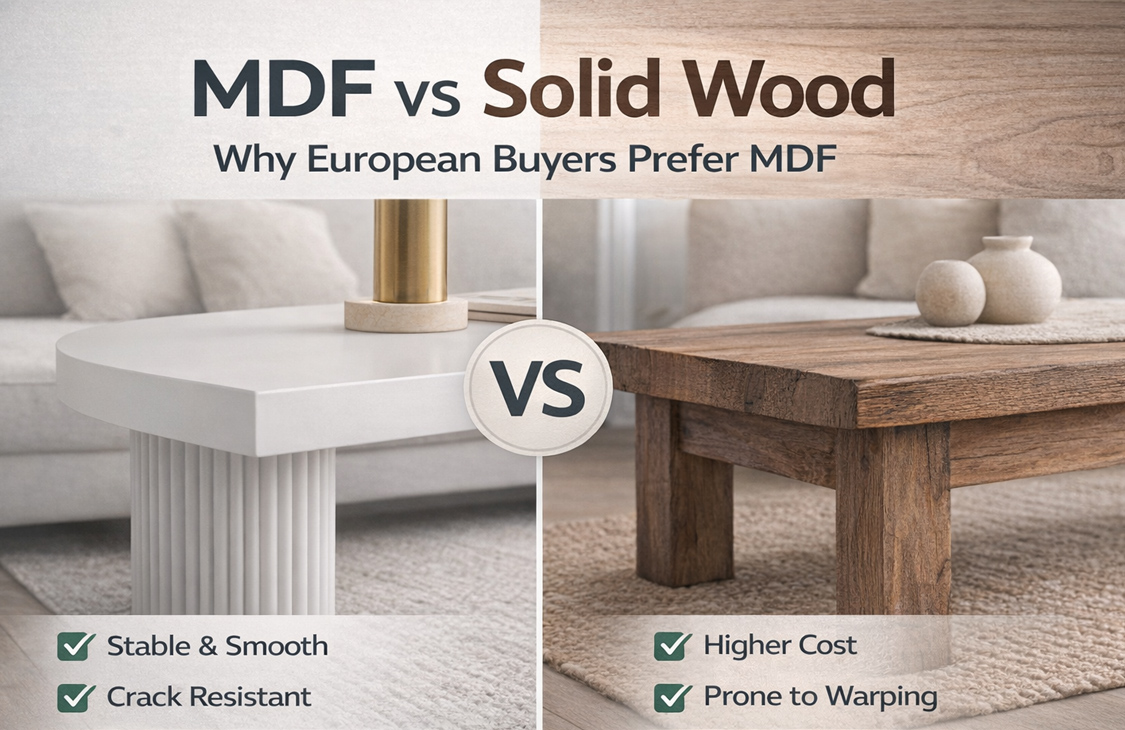
In 2026, a clear shift is taking place across the European furniture market. Increasingly, retailers, e-commerce brands, supermarket chains, and hospitality buyers are choosing MDF furniture over traditional solid wood furniture.
This shift is not about MDF being “lower quality.” Rather, it reflects a more mature and strategic purchasing logic. For European importers, the material decision is no longer purely about natural aesthetics — it is about supply chain efficiency, cost stability, climate performance, and large-scale consistency.
As return rates and operational costs rise in European retail and e-commerce, the debate of MDF vs solid wood has become a key decision point for furniture sourcing.
1. Cost Structure: Why Scalable Retail Favors MDF
In European retail systems, cost is not simply the unit price — it is long-term price stability and reproducibility.
Solid wood furniture is heavily influenced by natural resource supply. Timber grades vary significantly, raw material prices fluctuate, cutting waste is high, drying cycles are long, and skilled labor is required. These factors make cost structures less predictable over time.
By contrast, Medium Density Fiberboard (MDF) is industrially manufactured, offering higher raw material utilization, shorter and more controllable production cycles, and greater cost stability.
For large European retailers, Amazon sellers, and supermarket systems, predictable pricing and repeatable production are more important than individual material attributes. In a market increasingly focused on value for money, MDF furniture aligns better with scalable retail strategies.
2. Climate Stability: Better Adaptation to European Conditions
Europe experiences significant humidity and seasonal variation, particularly in countries such as Germany, France, and the Netherlands.
Solid wood is naturally prone to:
· Cracking
· Warping
· Joint separation
· Surface deformation
These issues often appear after products reach consumers, leading to returns and complaints.
High-quality MDF, however, is engineered through drying and compression processes that create uniform internal density and controlled moisture levels. As a result, MDF is less affected by seasonal humidity changes.
For export furniture, structural stability translates directly into:
· Lower after-sales risk
· Fewer customer complaints
· More consistent showroom presentation
This is one reason why MDF structures are increasingly adopted in European hotels, apartment projects, and commercial developments.
3. Surface Finishing Versatility: MDF’s Core Competitive Advantage
When comparing MDF vs solid wood furniture, surface finishing capability is one of MDF’s strongest advantages.
Because MDF has a smooth, uniform surface and consistent density, it provides exceptional flexibility for decorative applications. Solid wood, by contrast, is limited by natural grain variation and knot distribution, making certain visual effects difficult to replicate consistently in large volumes.
For European retail and e-commerce brands, the ability to achieve stable, repeatable finishes at scale is often more important than natural grain uniqueness.
Several MDF surface trends are particularly prominent in Europe during 2025–2026.
Travertine Look
Travertine-inspired finishes have become increasingly popular in minimalist and modern European interiors.
Through veneer application or specialized coating techniques, MDF can accurately replicate the porous texture and soft stone aesthetics of natural travertine while remaining lightweight.
Compared with real stone, MDF travertine-look furniture offers:
· Reduced weight
· Lower transportation costs
· Greater structural stability
· No cracking risks
This makes it particularly suitable for retail and hospitality projects.
-300x300.jpg)
AHOME® Set of 2 MDF Coffee Tables with Travertine Paper Finish, Modern Design
Marble Effect
Marble aesthetics remain a timeless choice for European commercial and hotel environments.
Using MDF combined with decorative surface techniques, manufacturers can achieve stable and controlled marble patterns without the heavy weight and fragility of natural stone.
For example:
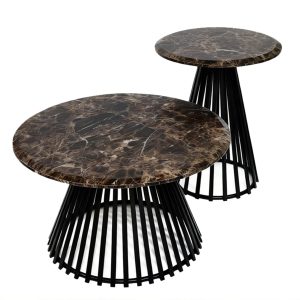
AHOME Marble Metal Side Table for Hotel Projects
This product uses MDF construction with a marble-effect surface finish, delivering an upscale look with lower shipping costs and improved durability — a practical solution for large-scale commercial procurement.
Wood Veneer Effect
Wood grain finishes remain a core demand in the European market. However, natural solid wood presents significant variation in grain patterns and color tone, making batch consistency difficult.
Through veneer lamination or melamine treatments, MDF can reliably replicate:
· Walnut grain
· Oak grain
· Light wood tones
· Dark wood finishes
For example:
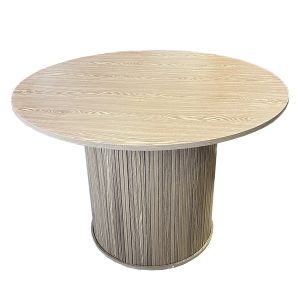
AHOME Fluted Round Dining Table in MDF
By combining MDF with veneer finishing, this design achieves a consistent wood appearance suitable for retail display and bulk production.
Gloss and Matte Painted Finishes
Modern minimalist interiors increasingly favor clean painted surfaces.
MDF’s smooth and even surface makes it ideal for:
· Matte finishes
· High-gloss coatings
· Cream and neutral color palettes
· Custom color development
For example:
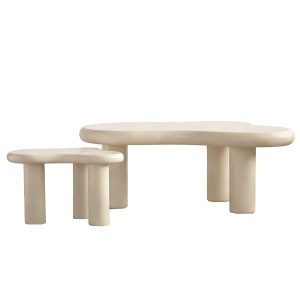
AHOME Cloud Shaped MDF Coffee Table
Compared with solid wood, MDF allows for more uniform paint adhesion and fewer surface imperfections, which is critical for e-commerce presentation and customer satisfaction.
Textured and Granular Finishes
Textured coatings and stone-like surfaces are gaining popularity in contemporary European design.
MDF can be engineered to achieve:
· Fine granular textures
· Coarse stone-inspired finishes
· Controlled surface consistency
Such finishes are far more difficult to standardize on natural wood due to grain irregularities.
Vintage and Distressed Finishes
Distressed aesthetics remain popular in Scandinavian and modern hybrid interiors.
For example:
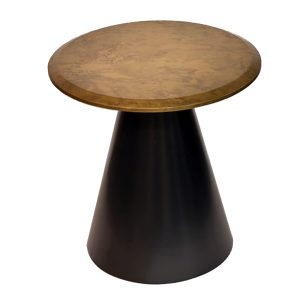
AHOME Scandinavian Modern Minimal Side Table
MDF allows for more controlled vintage brushing and color-wash techniques. In contrast, natural wood knots and grain variations can create inconsistent results across large production runs.
4. Batch Consistency: A Critical Factor for Retail Success
One of the defining characteristics of solid wood is that every board is unique. While this uniqueness may be valued in high-end custom projects, it presents challenges in mass retail.
In online sales environments, customers expect products to match listing photos precisely. Significant color or grain variation often increases return rates.
MDF, through standardized finishing and coating systems, enables greater batch uniformity. For brands operating at scale, consistency supports stronger brand identity and lower operational risk.
5. Why European Buyers Increasingly Choose MDF
From a commercial supply chain perspective, the advantages of MDF furniture are clear:
· More stable cost structure
· Better adaptation to European climate conditions
· Greater surface design flexibility
· Stronger batch consistency
· Better alignment with scalable retail and e-commerce models
This is not a debate about material hierarchy. It is a matter of supply chain efficiency and business model alignment.
6. AHOME’s MDF Furniture Solutions
As a manufacturer serving the European market for over 15 years, AHOME focuses on developing and producing MDF furniture and home décor products.
We support:
· Multiple surface finish customizations
· Color development
· Small batch testing
· Stronger batch consistency
· Stable large-scale production
Our MDF furniture collections are widely used by European retailers, e-commerce brands, and hospitality projects.
If you are looking for a reliable MDF furniture manufacturer for the European market, we welcome you to explore our solutions and product range.